
Ear wax is a normal part of how your ears stay healthy. The problem is that when too much builds up, the result can be muffled hearing, a blocked feeling, or discomfort that does not shift on its own. This guide walks through the most common signs that excess wax may be the cause, how microsuction works as a controlled removal method, and the situations where it is important to seek medical advice before booking any kind of wax removal. If you are in the North East and considering a home appointment, you will also find clear information on what is involved and how to book.
Hear Better provides home ear wax removal across the North East, so you can often get help without needing to travel into a clinic. The key is to understand when wax may be the issue and when it is better to seek medical advice first.
Why ear wax matters and why too much causes problems
Ear wax, properly called cerumen, is not something the body produces by mistake. It plays an active role in protecting the delicate skin of the ear canal, trapping dust and debris before they reach the eardrum, and keeping the ear naturally moisturised. For most people, most of the time, wax does its job quietly and is gradually moved out of the ear canal by the everyday movement of the jaw when chewing and talking. It dries, falls out, and the cycle repeats with no intervention needed.
Wax build-up is a common reason for blocked or muffled ears. The NHS guidance on earwax build-up explains the usual symptoms and self-care options. Local NHS provision varies, so people should check the route available in their area or arrange a private assessment if they prefer.
The trouble starts when that natural process is interrupted or overwhelmed. Some people simply produce more wax than others. Some have ear canals that are narrower or more curved, which makes natural clearance harder. And many people unintentionally make things worse by using cotton buds, which tend to push wax deeper into the canal rather than removing it. Hearing aid and earbud users are also more likely to experience build-up, because the device sits in the canal and disrupts the wax's normal path out.
What "impacted" wax actually means
You may see the phrase "impacted wax" used by audiologists and GPs. It refers to wax that has become compressed against the ear canal or the eardrum, often forming a firm plug. Impacted wax is the type most likely to cause noticeable symptoms, because it can physically block sound from reaching the eardrum. It is also the type that usually needs professional removal, since attempts to dislodge it at home tend to push it further in rather than out.
Nine common signs you may have excess ear wax
Not every blocked-ear feeling is caused by wax, but there are some clear signs that make it likely. If two or three of the following sound familiar, it is worth getting checked.
One symptom on its own is not necessarily wax. Several together, particularly muffled hearing combined with fullness or itching, usually points to build-up that would benefit from professional removal.
- a muffled or dull quality to your hearing, especially on one side
- a sense of fullness or pressure inside the ear, similar to how ears feel on a plane
- reduced hearing that came on gradually over days or weeks
- itching inside the ear canal
- mild ache or intermittent discomfort, with no obvious cause
- hearing aids or earbuds whistling, feeling loose, or sounding different
- a ringing, buzzing or hissing sound in the affected ear (tinnitus)
- an occasional dizzy or off-balance feeling when moving your head
- sound that seems clearly different between your two ears
What is microsuction ear wax removal?
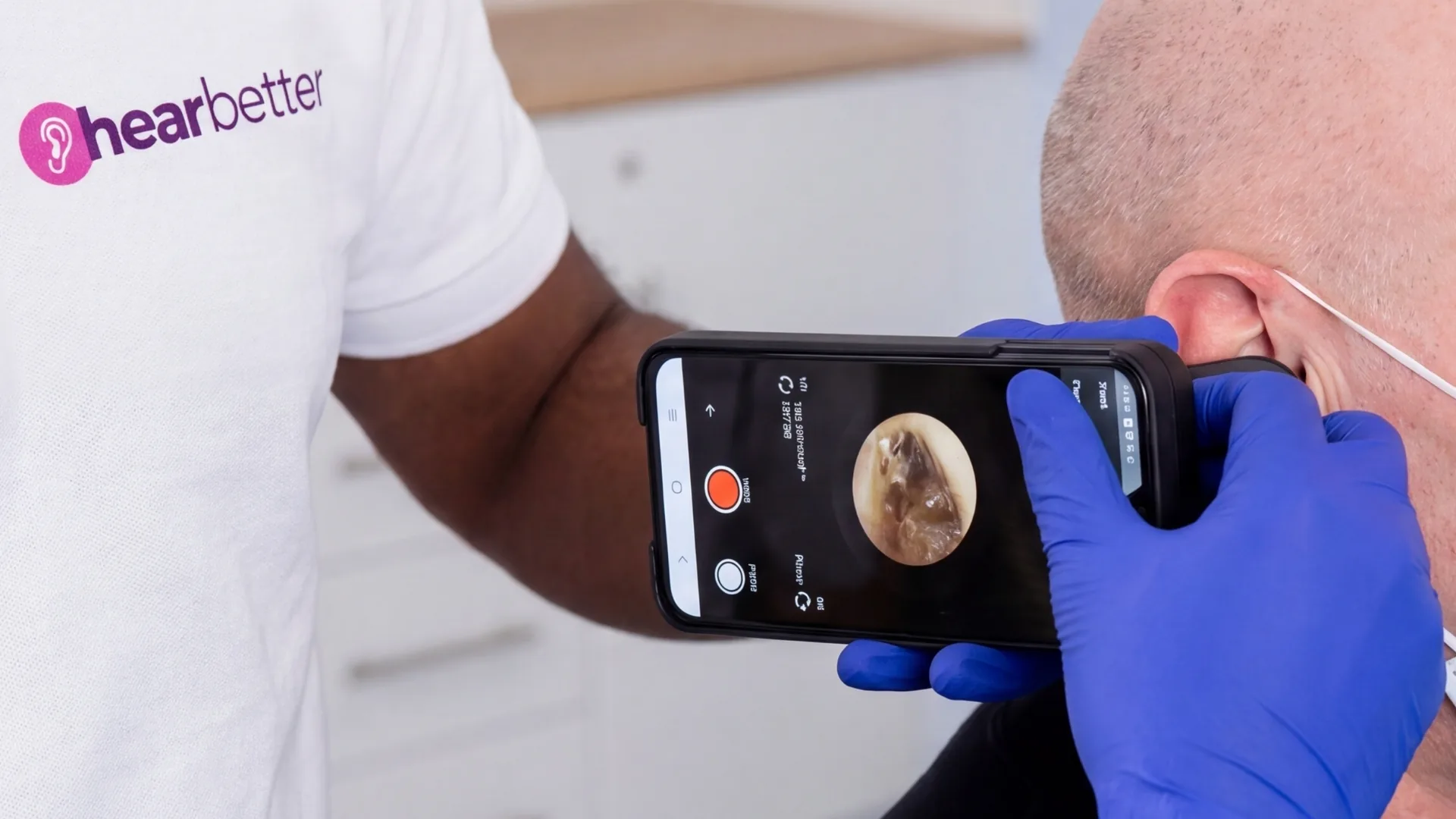
Microsuction is widely used as a controlled method for removing ear wax. It uses a fine suction device, a little like a very small vacuum, to gently lift wax out of the ear canal under direct view. Your audiologist uses a microscope or loupes with a bright light to see exactly what they are doing throughout, which means the procedure is precise rather than blind.
The removal part of an appointment is often completed within fifteen to thirty minutes, although this varies with the amount and consistency of wax. Microsuction does not introduce water and is performed under direct vision. A history of infection, perforation, grommets or ear surgery must still be discussed before treatment so the practitioner can decide whether and how removal should proceed.
How microsuction compares to other methods
Modern electronic irrigation and older manual syringing are not the same procedure. NICE guidance supports electronic irrigation, microsuction or another removal method such as manual removal when performed by a trained practitioner with the correct equipment, and advises against manual syringing. Pharmacy ear drops may soften wax, but product suitability and the person's ear history should be checked first.
Is microsuction painful?
Most people describe it as a strange sensation rather than a painful one. You will hear a noise from the suction device, which can sound loud because it is close to the eardrum, but the procedure itself does not normally hurt. If there is significant impacted wax or any inflammation in the canal, your audiologist will work slowly and check in with you throughout. If anything feels uncomfortable, you can ask them to pause.
Why choose home ear wax removal?
For many people, the biggest barrier to sorting out a blocked ear is the practicality of getting to an appointment. A home visit removes the travel, the parking, the waiting room, and the disruption to your day. Your audiologist arrives with portable but fully professional equipment, sets up in a well-lit room, and carries out the same procedure you would receive in a clinic.
That convenience matters most for certain groups. Older adults often find clinic visits tiring, particularly if mobility is limited. Parents and carers find it easier to arrange a single home appointment than to coordinate transport for an elderly relative. People with busy work schedules can often fit a home visit into a lunch break in a way a clinic visit simply does not allow. And anyone who feels self-conscious about hearing or ear issues often finds the privacy of their own home much more relaxing than a public waiting area.
Where Hear Better covers in the North East
Hear Better provides home ear wax removal across the North East of England, including Newcastle, Sunderland, Durham, Gateshead, South Shields, Middlesbrough, Stockton, Hartlepool, Darlington and the surrounding towns and villages. If you are unsure whether your address is within the service area, Hear Better will confirm availability when you get in touch.
When to seek medical advice first
A blocked ear is not always caused by wax, and some symptoms need to be assessed by a GP or other medical professional before any kind of wax removal is appropriate. Treating these as a simple wax issue can mean missing something more important, so it is worth being clear about the warning signs.
If you have severe pain, discharge, bleeding, dizziness, fever or signs of infection, do not try to sort it out on your own. Seek medical advice first so the cause can be assessed properly.
Warning signs that need urgent medical advice
Sudden hearing loss should be treated as urgent. NICE recommends immediate referral when hearing loss develops suddenly over three days or less and occurred within the past 30 days. Contact NHS 111 or urgent medical care rather than booking routine wax removal.
You should also speak to a GP or 111 before booking wax removal if you have:
- sudden hearing loss that came on within hours or overnight
- severe ear pain that is getting worse
- discharge or bleeding from the ear
- significant dizziness, vertigo, or loss of balance
- a high temperature or other signs of infection
- recent ear surgery or a known perforated eardrum that has not been assessed
- hearing loss following a head injury or loud noise exposure
What about pain after a flight or a cold?
Ear pain or fullness that appears alongside a cold, sinus infection, or after flying is often caused by pressure imbalance or fluid behind the eardrum rather than wax. These usually resolve on their own once the underlying cold clears, although they can take a couple of weeks. Wax removal is not normally the right answer in these situations, so it is worth getting checked first if you are not sure.
Booking home ear wax removal in the North East
If you have recognised some of the signs above and think excess wax may be affecting your hearing, the easiest next step is to get in touch with Hear Better. Hear Better will talk through your symptoms, check that home microsuction is the right service for you, and arrange a time that suits.
If you are not sure whether the issue is wax, a hearing change, or something that needs a GP first, that is fine too. A short conversation on the phone is usually enough to work out the best starting point, with no pressure to book if another route would be more appropriate.
Read more on the home ear wax removal service page or contact Hear Better.
What to avoid: unsafe DIY methods
A quick search online turns up plenty of suggestions for removing ear wax at home. Most of them are at best ineffective and at worst genuinely harmful. It is worth knowing what to steer clear of.
Cotton buds
Cotton buds are the single most common cause of impacted wax. They can remove a small amount of wax from the outer ear, but they tend to push the deeper wax further down the canal, compressing it against the eardrum. That is exactly the situation that causes blockage and muffled hearing, so reaching for a cotton bud when your ear feels blocked usually makes the problem worse.
Ear candles
Ear candling is widely marketed as a natural wax removal method and has no clinical evidence behind it. Studies have consistently shown that the residue left in the candle after use is from the candle itself, not from ear wax. The practice also carries a real risk of burns, hot wax dripping into the ear canal, and perforation of the eardrum. It is not recommended by any reputable audiologist or ENT specialist.
Sharp objects of any kind
Hairgrips, paperclips, pen lids, and similar items should never go into the ear canal. The skin lining the canal is very thin, the eardrum sits just a few centimetres in, and even a small scratch can lead to infection.
Over-the-counter ear vacuums
Cheap suction devices sold online are not the same as professional microsuction equipment. They produce far weaker suction, are not used under direct view, and have very little evidence that they work. They are unlikely to cause serious harm, but they are also unlikely to solve the problem.
The one home option that is reasonable, for mild build-up only, is olive oil drops. Pharmacy-grade olive oil ear drops, used twice a day for three to five days, can soften wax and sometimes allow it to clear naturally. They are also commonly recommended in the few days before a microsuction appointment to make removal easier.
How much does home ear wax removal cost?
Hear Better keeps pricing for home ear wax removal clear and straightforward, with no hidden fees once the appointment is booked. Current prices are listed in full on the home ear wax removal service page, so you can check before you decide. The fee covers the home visit, the assessment, and the removal itself.
If during the visit your audiologist finds that microsuction is not appropriate, for example if a GP review is needed first, you will be told straight away and the situation will be explained clearly. The aim is for every appointment to leave you better informed, not just sold a service.
Frequently asked questions
How long does a home ear wax removal appointment take?
Most appointments take around thirty minutes from start to finish, including a short conversation about your symptoms, an examination of both ears, and the removal itself. More complex cases can take a little longer.
Will my hearing be back to normal straight away?
Hearing often improves when confirmed wax blockage is successfully removed, but the result varies. If hearing does not return to its previous level, there may be another or additional cause, and your audiologist may recommend a full hearing test or medical assessment.
Do I need to use ear drops before the appointment?
It is helpful but not always essential. Two or three days of olive oil drops in each ear, twice a day, softens wax and makes removal smoother. Your audiologist will let you know if drops are recommended in your specific case when you book.
Is microsuction safe if I wear hearing aids?
Yes. In fact, regular microsuction is often recommended for hearing aid users, because the devices sit in the canal and tend to cause more wax build-up over time. Keeping the canals clear helps the aids work better and last longer.
Can children have microsuction?
Microsuction can be appropriate for older children in some cases, but it depends on the child and the situation. Children's ear concerns are usually best assessed by a GP first, who can refer to a paediatric audiologist or ENT specialist if needed.
What if I have a perforated eardrum?
Microsuction is generally considered safer than water-based methods for people with perforations, because it keeps the canal dry. That said, you should always mention a known perforation when you book, so your audiologist can assess whether removal is appropriate and adjust their approach.