
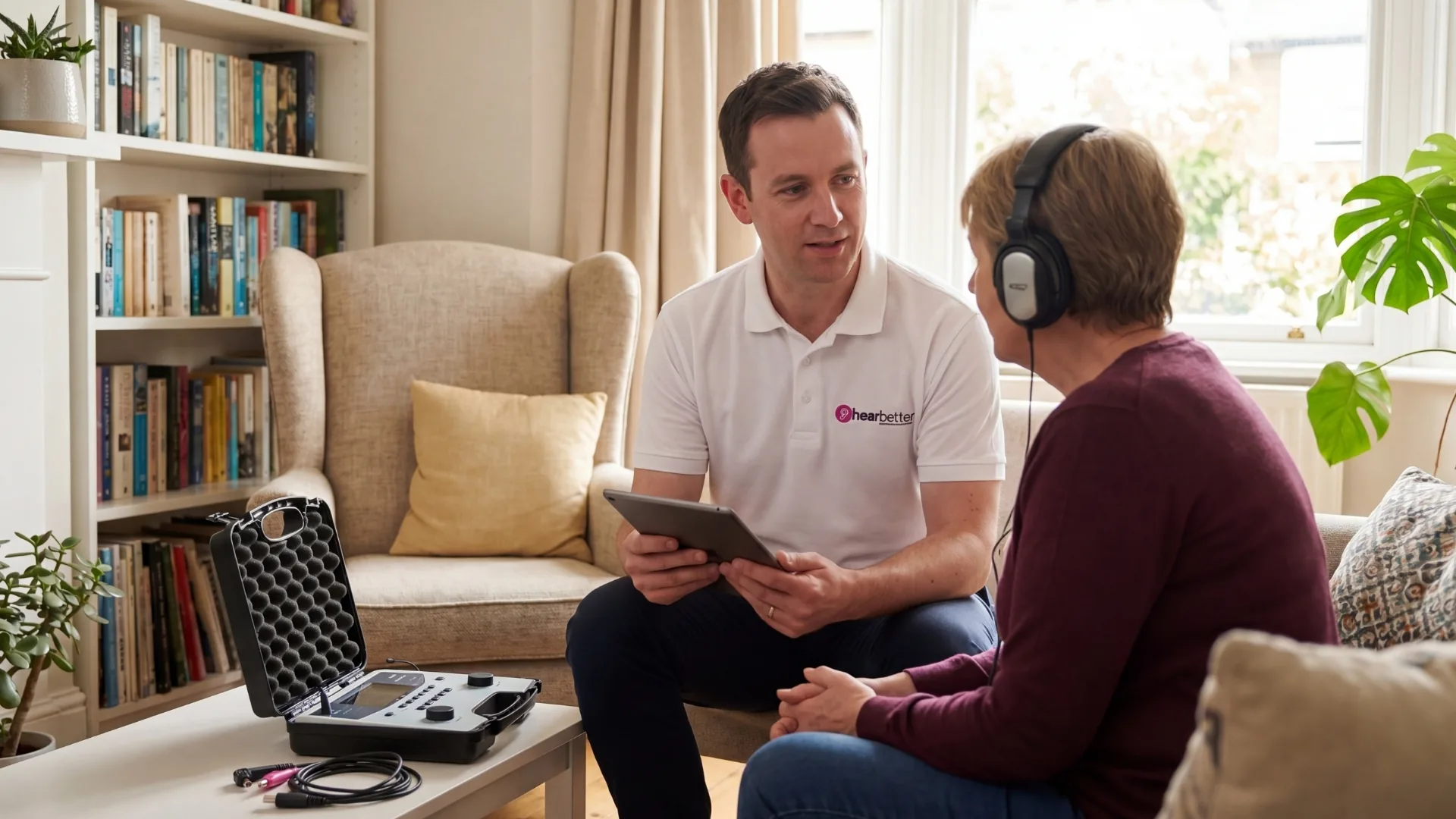
A home hearing test is one of the simplest, most relaxed ways to check your hearing, but if you have never had one before, it is natural to wonder what actually happens. This guide walks you through every stage of a Hear Better home appointment, from the first phone call to your results, so you know exactly what to expect before you book.
Whether you are arranging a test for yourself or helping a parent, partner or relative, you will find clear answers to the most common questions below. If you are ready to arrange an appointment rather than research the process, go directly to our free home hearing test service. Families can also use our practical guide to booking a hearing test for a parent.
Why people choose a home hearing test
For many people, the hardest part of getting a hearing test is not the test itself, it is getting to the appointment. Travel, parking, waiting rooms and unfamiliar surroundings can all add friction, especially for older adults or anyone with mobility concerns. A home hearing test removes those barriers entirely. Your audiologist comes to you, sets up specialist equipment in your living room or at your kitchen table, and carries out the same professional assessment you would expect from a high street clinic.
There is another, less obvious benefit. Your home is the environment where you actually listen to family conversations, the television, phone calls, the kettle, the doorbell and everyday sounds. Being assessed in that setting can help your audiologist understand how your hearing performs in the situations that matter most to you, rather than only discussing your hearing in a clinic setting. RNID's current UK estimates show how common hearing loss is, so lowering the practical barrier to a first test can make a real difference.
Who home hearing tests are suitable for
Home hearing tests are appropriate for most adults who want a professional hearing assessment without visiting a clinic. They are particularly helpful for people who:
- find travelling to appointments difficult or tiring
- live in a rural part of the North East where the nearest clinic is a long drive
- are arranging a test on behalf of an elderly parent or relative
- feel more comfortable discussing personal health matters in their own home
- want a calmer, less clinical appointment without time pressure
- have already worn hearing aids and want a private review at home
They are not only for older adults. Anyone noticing changes in their hearing, at any age, can benefit from a home appointment, particularly if a clinic visit feels like a barrier rather than a help.
Before your appointment: what Hear Better will ask
When you first get in touch, Hear Better will ask a few straightforward questions to make sure the right appointment is booked. These usually cover who the test is for, where you are based, what kind of hearing concerns have prompted the call, and whether you already wear hearing aids. None of this is a clinical assessment over the phone. It is simply to plan the visit properly and confirm that you are within the home visit service area.
You do not need to prepare extensive notes, but a few minutes of reflection beforehand makes the appointment more productive. It helps to think about when you first noticed changes in your hearing, whether one ear feels different from the other, and which everyday situations are most difficult. For example, you might notice difficulty with conversations in restaurants, hearing the television clearly, following group discussions, or understanding someone when they are speaking from another room.
What happens during the hearing test?
A Hear Better home hearing test usually takes between 45 minutes and an hour, sometimes a little longer if there is a lot to discuss. The appointment follows a clear, structured process, similar to what you would experience in a clinic, but delivered in your own home with portable, professional equipment.
Step 1: A conversation about your hearing
The appointment begins with a relaxed conversation. Your audiologist will ask about the hearing concerns that prompted the booking, when you first noticed changes, and whether there is any family history of hearing loss. They may also ask about general health factors that can affect hearing, such as recent ear infections, exposure to loud noise at work, or medication.
This part of the appointment is just as important as the test itself. It gives your audiologist the context they need to interpret the results properly. Two people can have similar hearing test results but very different everyday listening experiences, so understanding your lifestyle, concerns and priorities helps make the advice more useful.
Step 2: A physical check of your ears
Next, your audiologist will examine your ears using an otoscope, which is a small handheld light. This is a quick, painless check to look for anything that might affect your hearing or the test results, most commonly a build-up of ear wax.
If significant wax is present, your audiologist will discuss the options with you. Depending on the situation, this may include arranging ear wax removal before completing the hearing test. This is because wax can sometimes affect the accuracy of the results, so it is important that the ear canal is clear enough for the assessment to be useful.
Step 3: The hearing assessment itself
The hearing test uses professional audiometric equipment designed for home appointments. The core assessment is pure tone audiometry, the same standard test used in clinics and NHS audiology departments. You wear a set of headphones and listen for a series of tones at different pitches and volumes, covering the frequency range most important for speech, and respond each time you hear one. Your audiologist tests each ear separately, building a chart called an audiogram that maps the quietest sounds you can hear at each frequency, measured in decibels of hearing level.
Where appropriate, your audiologist may also discuss how you hear speech in everyday listening situations, especially if your main difficulty is following conversation in background noise. This is often one of the most important parts of understanding real-world hearing, because many people do not struggle in silence. They struggle in restaurants, family gatherings, meetings, busy rooms and places where several sounds are happening at once.
Step 4: Talking through your results
Once the testing is complete, your audiologist will walk you through the results in plain English. You will see your audiogram and have it explained clearly, including what each part of the chart means and how your hearing relates to everyday listening. If you want to understand the graph before or after the appointment, read our guide to how to read an audiogram.
There is no pressure and no jargon. The aim is for you to leave the appointment genuinely understanding what was found, what it might mean, and what your options are. If something does not make sense, you can ask questions there and then.
If hearing aids may help, the next step is to compare the hearing aids Hear Better fits around your results, listening goals, comfort and budget. The test does not commit you to proceeding.
Will I get results straight away?
Yes, in most cases, you will receive your results during the appointment itself. There is no long waiting period and no follow-up letter needed before you understand the main findings. Your audiologist will explain what the results show, whether any change in your hearing has been detected, and what your options are if action is recommended.
It is worth saying clearly: not every hearing test ends with a recommendation for hearing aids. Sometimes the outcome is reassurance that your hearing is within expected ranges. Other times, your audiologist may recommend monitoring things and booking a follow-up in the future. If hearing aids or further support could genuinely help, your audiologist will explain why, what the options look like, and what they may cost. You can review how to choose the right hearing aid after your results, what private hearing-aid prices should include and what happens at the fitting before deciding. The decision is always yours, and there is no pressure to commit on the day.
Signs it might be time to book a hearing test
Hearing changes often happen so gradually that you do not notice them yourself. Often, the people around you notice first. If any of the following sound familiar, a hearing test is a sensible step:
- struggling to follow conversations in background noise, such as cafés or family gatherings
- asking people to repeat themselves more often than you used to
- finding the television or radio harder to follow at comfortable volumes
- a sense that one ear feels different or weaker than the other
- ringing, buzzing or whistling sounds in one or both ears
- family members commenting that you have turned the volume up
- feeling more tired after social occasions because listening takes more effort
Any one of these on its own is not necessarily a cause for concern, but two or three together is usually a good reason to get checked. Catching changes early gives you more options and can make any recommended next step easier to understand.
Home hearing tests across the North East
Hear Better provides home hearing appointments across the North East of England, including Newcastle, Sunderland, Durham, Darlington, Middlesbrough, Stockton-on-Tees and Hartlepool, plus surrounding communities.
Because your audiologist travels to you, there is no need to find a clinic with parking, wait in a busy reception, or rearrange your whole day around an appointment. For families arranging hearing care for an older relative, the home visit is often the difference between a test getting booked and getting put off. It removes most of the friction and lets the appointment happen in a setting that feels familiar and comfortable.
Home appointments can also be useful for people who work from home, people with caring responsibilities, or people who simply prefer private appointments without the feel of a busy high street setting.
Where a test confirms an aidable hearing loss, you can also read how home assessment, fitting and lifetime support work for hearing aids in Stockton-on-Tees and hearing aids in Hartlepool.
How much does a home hearing test cost?
Hear Better offers free home hearing tests across the service area. There is no charge for the appointment itself, no obligation to take any next step, and no pressure to commit to hearing aids or further treatment.
If a follow-up service is recommended, such as ear wax removal or hearing aid support, this will be explained separately and only proceeds if you choose to go ahead. The aim is to give you clear information first, so you can make a confident decision.
Frequently asked questions
How long does a home hearing test take?
Most appointments take between 45 and 90 minutes, depending on how much there is to discuss. It is worth allowing a clear hour or more so nothing feels rushed.
Do I need a referral from my GP?
No referral is needed for a private home hearing test with Hear Better. You can book directly. If your audiologist identifies anything during the appointment that would benefit from GP or ENT input, they will explain why and talk through the next step.
Can I have a home hearing test if I already wear hearing aids?
Yes. Home appointments can be suitable for existing hearing aid users who want their hearing reviewed, their devices checked, or advice on whether their current setup is still right for them.
What if there is wax in my ears on the day?
If wax is found during the otoscopic check and it is significant enough to affect the test, your audiologist will discuss your options. In some cases, ear wax removal can be arranged as a separate appointment, after which the hearing test can be carried out properly.
Is the home test as accurate as a clinic test?
A home hearing test can provide a professional hearing assessment using suitable equipment in a familiar setting. Your audiologist will explain the results clearly and advise if any further assessment or referral is needed.
Book a free home hearing test
If you would like to arrange a home hearing test, the easiest next step is to get in touch with Hear Better. They will confirm whether you are within the service area, answer any questions about the appointment, and find a time that suits you.
If you are not sure whether a hearing test, ear wax removal or another service is the right starting point, Hear Better can help you work that out on the phone.
Read more on the home hearing test service page or contact Hear Better