
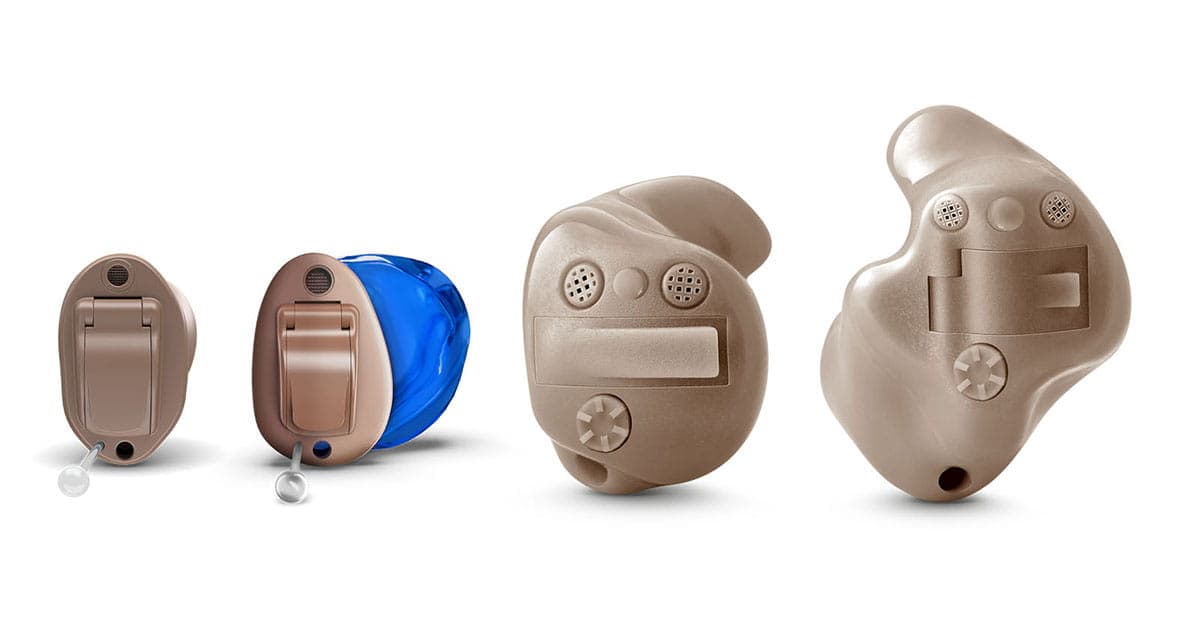
Invisible hearing aids usually mean custom devices that sit completely or very deeply inside the ear canal. The smallest are called invisible-in-canal, IIC, and completely-in-canal, CIC, hearing aids. They can be barely noticeable from the side, but discretion comes with practical trade-offs in power, handling, battery size, microphones and wireless connectivity.
A small hearing aid is not automatically a better hearing aid. The useful question is whether the style can meet your hearing prescription, remain comfortable, resist the effects of wax and moisture, and provide the controls or phone features you will actually use.
Start with a proper hearing assessment. Ear health, canal shape, hearing level, eyesight and dexterity can rule a style in or out before brand or colour is considered.
Invisible hearing-aid styles at a glance
| Style | Where it sits | Visibility | Common strengths | Main trade-offs |
|---|---|---|---|---|
| IIC | Deep in the ear canal | Usually the least visible | Maximum discretion; uses the outer ear's natural shape | Small battery; limited controls and wireless features; can be fiddly |
| CIC | Mostly inside the canal | Very discreet, with a small removal line | Custom fit with slightly more room than IIC | Connectivity and power still vary; wax exposure; small controls |
| ITC | Partly in the canal | Visible when viewed from the side | More room for battery, microphones and controls | Less discreet than CIC or IIC |
| ITE | Fills part of the outer ear | Clearly visible from the side | Larger controls; potentially easier handling and more features | Larger shell and greater visibility |
| RIC or RITE | Small case behind the ear with a receiver in the canal | Often discreet rather than invisible | Broad fitting range, rechargeability, directional microphones and connectivity | A small section remains behind the ear; receiver needs maintenance |
The NHS describes CIC and IIC devices as the smallest available styles, while also warning that they may not provide enough power for severe hearing loss and can be fiddly to manage. That is why appearance should be considered alongside the complete fitting rather than treated as the first filter.
What is an IIC hearing aid?
An invisible-in-canal hearing aid is made to fit deeply inside the ear canal. A small removal cord normally remains accessible. Its position can make it very difficult to see in many ears, although no provider should guarantee that a device will be invisible from every angle.
An IIC may be worth discussing when:
- The hearing loss is within the fitting range of the exact product.
- The ear canal is large and healthy enough for a deep custom shell.
- Maximum discretion matters more than rechargeability or direct streaming.
- The wearer can insert, remove and clean a very small device reliably.
- Wax and moisture are not likely to make the fitting impractical.
The deep position is not suitable for every ear. Narrow or sharply curving canals can leave too little usable space. Recurrent ear infections, heavy wax, skin problems or discomfort may also make another style more sensible.
What is a CIC hearing aid?
A completely-in-canal hearing aid sits slightly nearer the canal entrance than an IIC. It is still very discreet but may provide more room for the receiver, battery or controls. Some current CIC products are rechargeable or connected, while others deliberately sacrifice wireless features to remain smaller.
Do not assume every CIC carrying the same product-family name has the same functions. The shell size, technology level and optional components can change whether it includes:
- Direct phone streaming.
- App control.
- A rechargeable cell or replaceable battery.
- Directional microphones.
- A telecoil.
- A manual programme or volume control.
Those details should be confirmed for the exact model on the written recommendation, not inferred from a photograph of the range.
Are RIC hearing aids almost invisible too?
Receiver-in-canal, RIC, or receiver-in-the-ear, RITE, hearing aids are not technically invisible because a small case sits behind the ear. In practice, a slim case matched to the hair or skin, with a fine receiver wire, can be difficult to notice during normal conversation.
RIC devices are often the stronger compromise when someone wants discretion without giving up:
- Rechargeable power.
- Two separated microphones for directional processing.
- Direct phone and television streaming.
- A broader fitting range.
- Easier physical controls.
- The option to change receiver power or earpiece as needs change.
Glasses do not automatically rule out RIC hearing aids. The frame, ear shape, receiver wire and device position should be checked together. A discreet custom device is not a better solution if it is harder to handle or cannot provide a required feature.
Do invisible hearing aids work for severe hearing loss?
The smallest canal aids are commonly intended for mild-to-moderate or selected more substantial losses, but the fitting range differs by model. A severe or profound hearing loss may require more receiver output, ventilation control, battery capacity or feedback management than a very small shell can provide.
A power RIC or behind-the-ear aid with a custom earmould can be the safer and more effective choice. If both ears have aidable hearing loss, NICE recommends offering two hearing aids and explaining the potential benefits for speech in noise, sound location and sound quality.
The audiogram is only part of the decision. Speech understanding, uncomfortable loudness levels, ear health and whether the sound can be delivered without feedback also matter.
Bluetooth, phone calls and invisible hearing aids
Wireless signals and small custom shells compete for physical space. Some modern in-ear devices offer direct streaming, app control and rechargeability, but the deepest IIC products often have fewer wireless functions.
Before ordering, check the exact aid against the exact phone. Ask:
- Does it stream calls and media to both ears?
- Are calls hands-free, or does the phone still act as the microphone?
- Does it support the phone's operating system and current version?
- Is app control available without increasing the shell size?
- What television or remote-microphone accessory is required?
- How does streaming affect battery life?
Our Bluetooth and phone compatibility guide explains why a generic Bluetooth badge is not enough.
Rechargeable or replaceable batteries?
Rechargeable custom hearing aids are now available in selected ranges, but not every ear can accommodate the required shell and charging contacts. Replaceable zinc-air batteries may allow a smaller casing, although changing them can be difficult for someone with reduced dexterity or eyesight.
Compare the whole routine:
- Can you remove the aids safely every evening?
- Can you place them correctly in the charger?
- Can you change a very small battery without dropping it?
- Is a full day's expected runtime enough for your use?
- What happens during travel or a power cut?
There is no sound-quality advantage created by the power source alone. Read the full rechargeable versus battery comparison.
Wax, moisture and maintenance
Canal devices sit in a warm environment and are exposed directly to wax and moisture. Their microphone and receiver openings need routine inspection. Wax filters may need changing more frequently than on a behind-ear device, depending on the ear.
A provider should show you how to:
- Wipe the shell without forcing debris into an opening.
- Check and replace the wax guard.
- Keep the microphone opening clear.
- Store or charge the aids safely overnight.
- Recognise when professional cleaning or repair is needed.
Do not insert sharp tools into the hearing aid or the ear canal. Persistent pain, discharge or a sudden change in hearing needs assessment rather than repeated cleaning at home.
Current discreet options worth comparing
Hear Better can compare custom and discreet products across several manufacturers. Depending on current UK availability and suitability, the discussion may include:
- Audio Service custom G8: a broad selection of ITE, ITC, CIC and discreet canal formats, with features varying by shell.
- Bernafon custom products: canal and in-ear choices in appropriate ranges, alongside conventional miniRITE options.
- Oticon Zeal and Own SI: current rechargeable in-ear and custom options with different sizes and wireless capabilities.
- Phonak Virto Infinio: custom products using the current Infinio platform, with functions determined by the selected format.
- Rexton Reach custom: selected rechargeable CIC and custom IIC, CIC, ITC and ITE configurations.
- Signia Silk and Insio: instant-fit or custom in-ear options for people prioritising a small form.
- Starkey custom products: a wide custom portfolio including very small canal devices and larger connected in-ear styles.
This is a comparison list, not a league table. Product availability, shell size and compatible features should be reconfirmed before ordering.
How much do invisible hearing aids cost?
Price depends on the technology level, whether one aid or a pair is required, the custom manufacturing, charger or accessories, warranty and included aftercare. A smaller aid is not automatically cheaper; a premium IIC can cost more than a larger model with broader features.
Ask for one complete written figure covering the exact products and support. Our guide to private hearing-aid prices explains what should be included.
How should you choose?
Use this order:
- Confirm the hearing loss and ear health.
- Identify styles that can meet the prescription safely.
- Check canal shape, comfort, wax and moisture.
- Handle the aid, battery or charger.
- Confirm required phone, television and accessory features.
- Compare realistic visibility rather than marketing photography.
- Review the complete price, warranty, trial terms and aftercare.
An invisible aid that stays in a drawer is not discreet hearing care; it is an unsuccessful fitting. The right aid is one you can wear, manage and hear through consistently.
Can Hear Better fit invisible hearing aids at home?
Yes, where the assessment shows that a custom canal style is appropriate. Hear Better can assess your hearing and ears at home, explain suitable IIC, CIC, ITC, ITE and RIC options, and take impressions where required. Recommendations are independent across leading manufacturers and include fitting and ongoing support across the North East.
The free hearing assessment does not oblige you to buy. If another style is likely to provide better hearing, handling or connectivity, that should be explained before an impression is taken.