
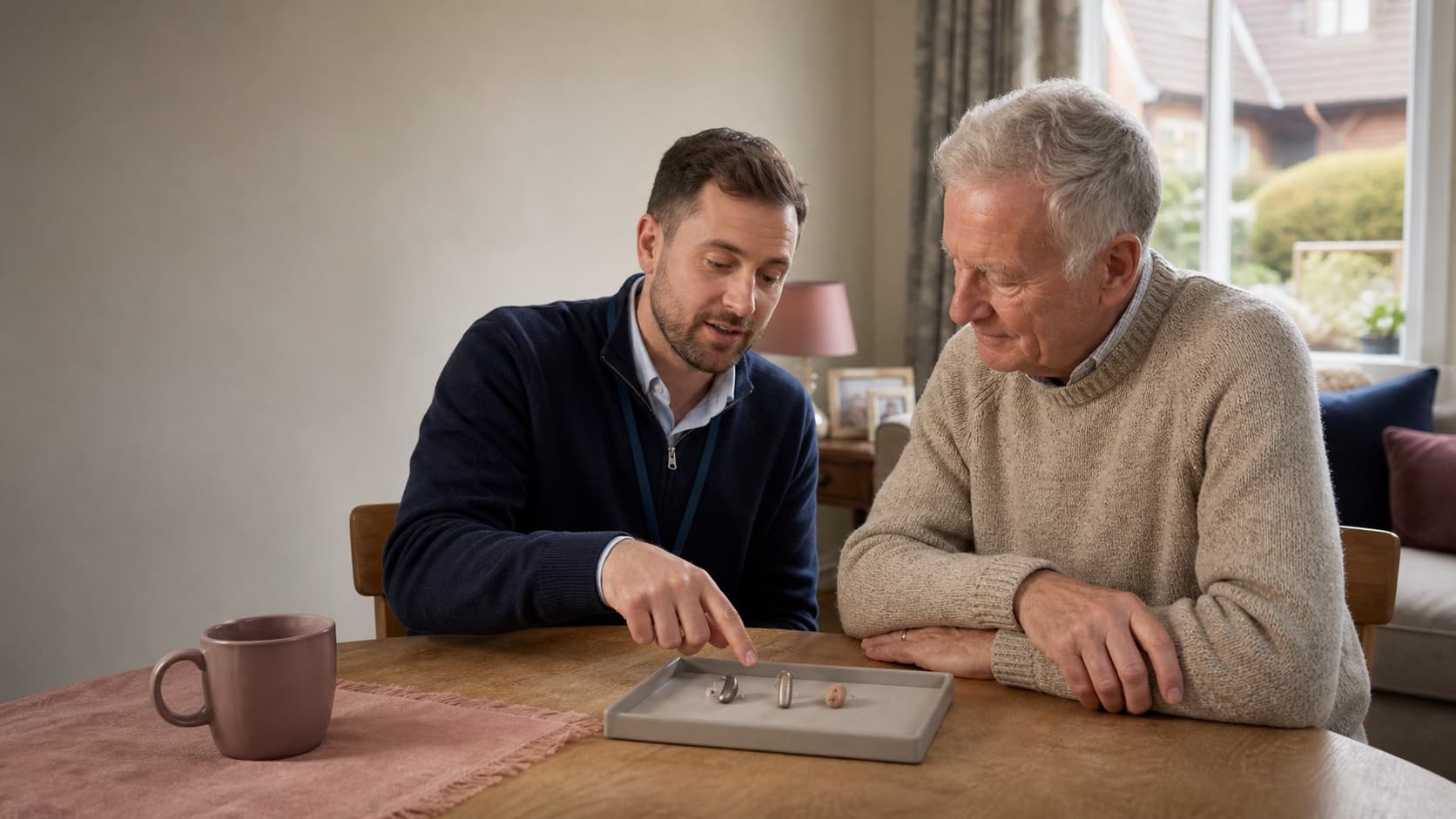
The right hearing aid is not simply the smallest, newest or most expensive model. It is a prescription device that suits your hearing loss, the conversations and places that matter to you, your ears and dexterity, the technology you will actually use, and the support available after fitting.
Start with a proper hearing assessment. Then compare clinically suitable options against specific daily goals, such as following family conversation, hearing television, using the phone or coping in a busy café. A good recommendation should explain why a particular style, feature level and fitting are appropriate, as well as their limitations.
What should determine your hearing-aid choice?
Use these factors in order:
- Your hearing assessment and ear health.
- Whether one aid, two aids or another pathway is appropriate.
- The situations in which you need help hearing.
- Physical comfort, ear shape, eyesight and dexterity.
- A style capable of meeting the acoustic requirements.
- Phone, television and accessory compatibility.
- Battery or charging practicality.
- Technology level and realistic benefit.
- Complete price, warranty and aftercare.
Brand can matter, but it comes after those questions. Leading manufacturers make strong products with different fitting ranges, accessories and connectivity. No brand is objectively best for every hearing loss and every person.
Begin with a full hearing assessment
A hearing aid should be selected from more than an online questionnaire or a list of symptoms. NICE guidance says an adult audiological assessment should include a relevant history, communication needs, expectations, mobility and dexterity, examination of the ears and pure-tone audiometry. Tympanometry may also be used when indicated.
The audiogram shows the quietest sounds detected at different pitches in each ear. It does not describe every real-world difficulty on its own. If the graph is unfamiliar, our guide to how to read an audiogram explains its symbols and limitations. Your audiologist should also ask where communication breaks down, what you already do to cope and which improvements would make the greatest difference.
Hear Better offers a free home hearing test across the North East. The results are explained before any recommendation, and the assessment does not oblige you to purchase hearing aids.
When is choosing a hearing aid not the first step?
Some symptoms require medical or specialist assessment rather than proceeding directly to a routine hearing-aid fitting. NICE identifies sudden or rapidly worsening hearing loss, certain one-sided or asymmetric losses, persistent one-sided or pulsatile tinnitus, recurrent vertigo, unresolved ear pain or discharge, and some abnormal ear findings as reasons for urgent or specialist referral.
Sudden hearing loss that developed over three days or less can be an emergency. Seek urgent medical help rather than waiting to compare hearing aids. An audiologist should also identify earwax, infection or other findings that need addressing before an impression or fitting.
Do you need one hearing aid or two?
If both ears have aidable hearing loss, NICE recommends offering two hearing aids. Its guidance explains that two aids can help with speech in background noise, locating where sound comes from and overall sound quality.
That does not mean every person needs two conventional aids or will prefer two. Direct trial evidence comparing one modern aid with two is limited, and individual benefit still needs reviewing. One-sided hearing loss, unaidable hearing in one ear, ear-health issues, personal preference and specialist pathways can change the recommendation. CROS, BiCROS, bone-conduction or implantable options may be considered in particular circumstances. These require individual assessment rather than self-selection.
Ask the provider to explain:
- what each ear can usefully contribute
- why one aid, two aids or another system is being proposed
- what benefit is realistic in quiet and in noise
- what happens if you begin with one aid and reconsider later
Which hearing-aid style is right for you?
Style should follow the hearing loss and practical requirements, not appearance alone. The NHS overview of hearing-aid types describes the main formats.
Compare the four main fittings
Start with the styles that can meet your prescription, then compare handling, comfort and features.
The versatile starting point
Receiver in the ear
A small case behind the ear connects to a receiver in the canal. It suits many hearing losses and can balance discretion, comfort and modern features.
Often valued for
- Broad fitting range
- Rechargeable options
- Strong phone and accessory choice
Check before choosing
The receiver and wax filter sit in the ear canal, and the small parts may be fiddly.
- Handling
- Moderate
- Visibility
- Discreet
These are useful starting points, not prescriptions. Your hearing results, ear health and acoustic needs decide which options are genuinely suitable.
The smallest aid is not automatically the easiest or best. A slightly larger device may offer clearer controls, a larger rechargeable battery, telecoil, stronger output or easier maintenance. A more open fitting can reduce the blocked sensation for some hearing losses, while a more closed dome or earmould may be needed to deliver lower-frequency sound, control feedback or provide sufficient power.
If a custom fitting is required, read how custom ear mould impressions are taken and when they may be useful.
Match the aid to your real listening environments

The best shortlist starts with the conversations and places where you most want to hear more clearly.
Write down three to five situations in which hearing is most difficult. Make them specific:
- talking with one person at home
- following several family members around a table
- hearing a partner in the car
- understanding a speaker at a community group
- watching television at a comfortable household volume
- making mobile phone or video calls
- listening to music
- working in meetings or customer-facing environments
This is more useful than saying that you want the “best” hearing aid. Different goals place different demands on microphones, processing, accessories, connectivity and physical fitting.
What helps with speech in background noise?
Directional microphones and noise-reduction systems can improve comfort or access to speech in some noisy situations. NICE says these features should be explained and that users should know how to select appropriate settings for different environments.
Our evidence-led comparison of hearing aids for background noise examines the current models, independent research, manufacturer claims and situations in which a remote microphone may help more.
No hearing aid can remove every unwanted sound or restore normal hearing. Performance changes with the direction and type of noise, room acoustics, distance from the speaker, the hearing loss, physical fitting and programming. A remote microphone placed closer to the speaker can sometimes provide a greater signal advantage than relying on the hearing aids alone.
If restaurants, meetings or group conversations are a priority, ask:
- Which features address that precise situation?
- Are they included at the quoted technology level?
- Do they work automatically or require a program change?
- Would a remote microphone be more useful?
- How will benefit be reviewed after fitting?
Consider dexterity, eyesight and daily handling
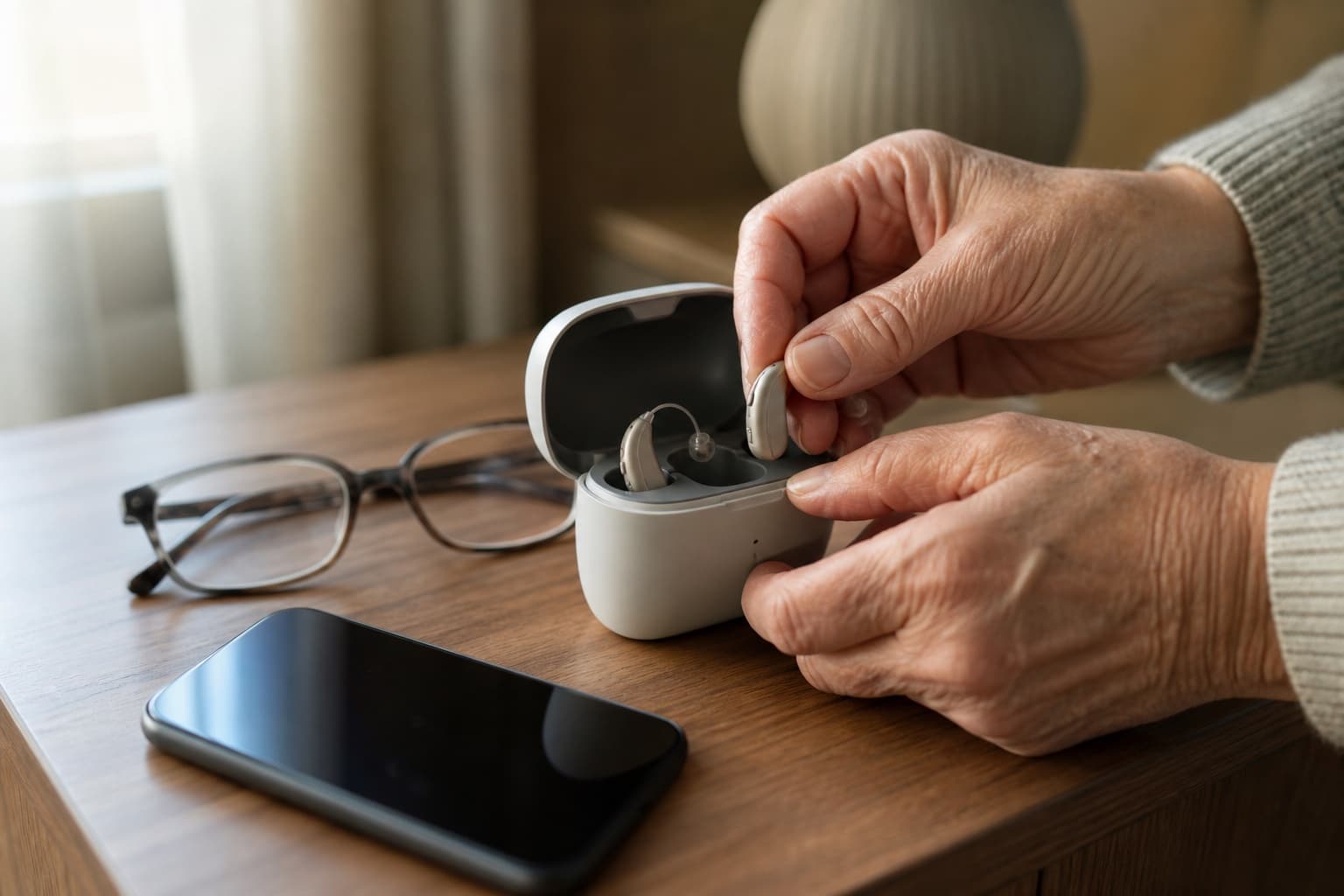
Insertion, charging and controls should feel manageable before you commit to a style.
An aid only helps when you can wear and manage it consistently. NICE specifically includes physical mobility and dexterity in the assessment.
Try the practical tasks before deciding:
- insert and remove the proposed style
- distinguish the left aid from the right
- place it correctly in the charger
- open a disposable battery door and handle the battery
- use any push-button or volume control
- change a dome or wax filter if this will be expected of you
- open and understand the app, if you plan to use one
Arthritis, tremor, reduced fingertip sensation or limited vision can make the smallest custom aids and batteries frustrating. A drop-in charger, larger BTE device, custom mould, retention piece or automatic controls may be more valuable than a discreet design.
Glasses, oxygen tubing, masks and headwear can also influence the position of an aid behind the ear. Bring or wear the items you use regularly when options are demonstrated.
Rechargeable or disposable batteries?
Neither is universally better.
Rechargeable aids avoid regular handling and purchase of small zinc-air batteries. They may suit people who can establish a nightly charging routine and use the charger reliably. Check expected use after a full charge, because streaming, demanding processing and battery age can affect runtime. Also ask what happens during a power cut, a trip away or eventual battery servicing.
Disposable batteries can be replaced immediately and may suit people who cannot rely on daily charging or need extended use away from electricity. They require safe storage and enough dexterity to handle a small battery. Button batteries can cause serious harm if swallowed, so they must be kept securely away from children and vulnerable adults.
The useful question is not which battery system is newer. It is which routine you can manage every day.
Check phone, app and television compatibility before ordering
The word “Bluetooth” is not a complete compatibility answer. Streaming, hands-free calls, app control and connection to several devices vary by hearing-aid model, phone model and operating-system version.
Apple advises checking its current Made for iPhone device list and system requirements. Google's Android accessibility information also warns that a tested combination does not guarantee every device, configuration or future update will work.
Before ordering, give the provider the exact model and operating system of your phone or tablet. Ask them to confirm:
- direct streaming for calls and media
- whether calls are hands-free or still use the phone microphone
- app compatibility and which controls the app provides
- whether two phones, a tablet or computer can be connected as required
- what television accessory is needed
- whether a telecoil is available for hearing-loop venues
Bluetooth LE Audio and Auracast are newer technologies with the potential to stream broadcast audio in compatible public venues. The Bluetooth Special Interest Group explains that LE Audio adds hearing-aid support and Auracast broadcast capability. However, an “Auracast ready” label does not prove that every function is active with your current phone or venue. Confirm the hearing aid, firmware, controlling device and local transmitter support.
Do not pay for connectivity you will not use. Equally, do not discover after purchase that an important phone or television function is missing.
Which other hearing-aid features are worth checking?
Treat every feature as a response to a real need, not a reason to buy on its own.
Telecoil and public hearing loops
A telecoil can send audio from an installed hearing loop directly into compatible aids. This remains useful in some theatres, places of worship, reception desks and public venues. Not every small or custom aid includes a telecoil, and the loop program may need enabling during fitting. Auracast may expand public broadcast audio over time, but it has not made existing loops universally obsolete.
Apps and remote support
Apps may provide volume, program, battery and find-my-aid functions, depending on the model and phone. A smartphone should not be necessary for basic hearing-aid use. If you do not want an app, confirm that automatic settings, physical controls or a separate remote will meet your needs. Remote adjustment is also provider and model specific, so do not assume an app means remote appointments are included.
Moisture and water resistance
Check the exact product's IP rating and manufacturer instructions. Water resistance can offer useful protection against sweat, rain and accidents, but it does not automatically make an aid suitable for swimming, showering or bathing. Protection can also change with age, wear and maintenance.
Tinnitus support
Hearing aids may help some people who have both tinnitus and hearing loss, and certain models include optional sound-support features. They are not a cure for tinnitus. NICE tinnitus guidance advises amplification where tinnitus accompanies hearing loss that affects communication, but not solely for tinnitus when there is no hearing loss. Persistent one-sided, pulsatile, changed or distressing tinnitus should be assessed appropriately.
“AI” and health features
Artificial intelligence, neural processing and automatic scene detection are not standardised benefit grades. Ask what the feature actually does, which model and tier include it, and whether the evidence comes from independent research or the manufacturer. Fall alerts, activity tracking and similar tools may be useful to some people, but they should not be assumed to be medical-grade monitoring.
Does a premium hearing aid always work better?
No. Higher technology levels can add processing channels, automatic environment classification, directional options, noise management and other features. Their value depends on the hearing loss and the environments in which you spend time.
A peer-reviewed study of hearing-aid technology level and listener outcomes found similar outcomes between technology levels on most measures at group level, with some advantages for premium devices in noise acceptance and satisfaction with speech in larger groups. This is a useful warning against two extremes: claiming premium technology never matters, or assuming it benefits everyone enough to justify the cost.
Someone regularly working, socialising or dining in complex noise may have more opportunity to use advanced processing. Someone whose main conversations are one-to-one in quiet may obtain the useful benefit from a lower level. The recommendation should connect each paid feature to a real listening goal.
Ask the provider:
- what changes between the quoted technology levels
- which difference is relevant to your own goals
- what evidence supports the claimed benefit
- whether the feature is available in the chosen style
- how performance will be checked in real life
Does the brand matter?
Yes, but it should not be the starting point. Manufacturers differ in fitting ranges, sound processing, accessories, apps, phone protocols, custom styles and specialist options. Individual sound preference can also differ.
What brand cannot tell you by itself is whether the aid is suitable for your prescription, fitted accurately or supported properly. Marketing terms such as “AI,” “natural sound” and “speech clarity” do not create a fair comparison unless the provider explains the exact model, technology level, evidence and limitations.
Hear Better is independent and can compare prescription aids from several leading manufacturers. The hearing-aid brand and technology guide explains the current ranges, who they may suit and what is worth checking. Brand recommendations should follow your assessment rather than precede it.
Fitting and aftercare matter as much as the device
Two people can have different experiences with the same model because prescription, physical fit, verification, counselling, expectations and fine-tuning all matter.
Before buying, ask how the aids will be programmed and checked. Our guide to what happens during a hearing-aid fitting explains the appointment, including physical comfort, programming, controls and follow-up.
NICE recommends offering a follow-up 6 to 12 weeks after fitting. It should review comfort, sound quality, volume, maintenance, phone use, assistive devices and progress towards the person's hearing goals. A provider may also arrange earlier adjustments.
Before you leave the fitting, make sure you can insert, charge and operate the aids. The hearing-aid care and maintenance guide explains daily care, safe storage and common troubleshooting.
Hear Better's service includes:
- fitting and adjustments at home
- a free hearing test every 12 months to recheck the prescription
- unlimited service call-outs to help keep the aids in working order
- advice by phone or email
- this aftercare for the lifetime of the aids, including after the manufacturer warranty ends
Manufacturer repairs, paid parts, loss and accidental damage remain subject to the applicable written terms. Ask for those terms before purchase.
Compare the complete price, not just the device
Check whether a quote is for one aid or a pair and whether it includes the assessment, fitting, charger, earmoulds, follow-ups, repairs, home visits and aftercare. Our guide to private hearing-aid prices and what should be included provides a complete comparison checklist.
NHS hearing aids are supplied free on long-term loan with batteries, repairs and aftercare. Private care may offer a wider choice of manufacturers, styles or appointment arrangements, but paying privately is not necessary to obtain modern digital hearing aids. Read the NHS and private hearing-aid comparison before choosing a route.
A practical hearing-aid comparison checklist
Compare the same clinical, practical and service information for every suitable option.
A clearer way to compare your shortlist
Clinical fit
Can it meet the prescription?
- Results and ear health explained
- One aid, two aids or another system
- Suitable style, dome or earmould
- Fitting and verification method
Daily life
Will it work where you need it?
- Your three priority listening situations
- Handling and charging tested
- Exact phone and television compatibility
- Features linked to a real need
Complete package
What happens after purchase?
- Written price for one aid or a pair
- Follow-ups and adjustments included
- Warranty, repairs, loss and damage terms
- Home visits and long-term aftercare
If a provider cannot explain these points clearly, do not let a discount deadline rush the decision.
Explore every hearing-aid guide
Use this page as your starting point, then open the detailed guide for the decision you are making. Together, these guides cover hearing-aid types, features, prices, fitting, aftercare and long-term ownership.
Questions to ask your audiologist
- What do my results show in each ear?
- Is there anything that requires medical or specialist referral first?
- Why are you recommending one aid, two aids or another system?
- Which styles are clinically suitable, and which are not?
- How does this recommendation address my three most important listening situations?
- Which features am I paying for at this technology level?
- Will it work with my exact phone and television setup?
- Can I insert, charge and maintain it confidently?
- How will it be programmed and verified?
- What follow-up, adjustments and annual reviews are included?
- What are the warranty, repair, loss and cancellation terms?
- What is the complete written price for the recommended number of aids?
Choosing hearing aids at home in the North East
Hear Better provides free home hearing tests, independent recommendations, home fitting and lifetime support across the North East. Local hearing-aid information is available for Newcastle, Sunderland, Durham and the wider North East service area.
Because Hear Better is fully independent, the recommendation is not restricted to one manufacturer. Liam Robson, HCPC registration HAD03779, can compare every major prescription brand against your results, budget and daily routine. If you proceed, fitting, adjustments and ongoing support take place at home, with lifetime aftercare included for as long as you wear the aids.
The aim is not to find a device that wins on a specification sheet. It is to choose an aid you can wear and manage, with the right acoustic performance and useful features for your life, fitted carefully and supported for the years you own it.
Frequently asked questions
What is the best hearing aid available?
There is no universal best hearing aid. The right model depends on the hearing loss, ear health, listening needs, dexterity, preferred style, required connectivity, budget and quality of fitting and follow-up.
Is the most expensive hearing aid always the best?
No. Premium levels may add useful processing for complex environments, but group research does not show a universal advantage on every outcome. Pay for features that address your documented listening needs rather than for the highest tier automatically.
Are in-the-ear hearing aids better than behind-the-ear aids?
Neither style is inherently better. Behind-the-ear and receiver-in-the-ear aids suit a wide range of losses and can offer easier controls or broader features. Custom in-the-ear aids may suit people who prefer a single-piece fitting, but smaller models can be harder to handle and may have feature or power limitations.
Should I choose rechargeable hearing aids?
Choose rechargeable aids if nightly charging is easier than handling small batteries and the expected runtime suits your day. Disposable batteries may be more practical when immediate replacement or extended use away from power matters.
Do all Bluetooth hearing aids work with every phone?
No. Streaming, hands-free calling and app functions vary by hearing-aid model, phone and operating system. Compatibility should be checked for the exact devices before the aids are ordered.
Can hearing aids remove background noise?
No hearing aid can remove all background noise. Directional microphones, noise management and remote microphones can help in particular situations, but benefit depends on the environment, hearing loss, fitting and distance from the speaker.
Sources
- NICE: Hearing loss in adults, assessment and management
- NHS: Hearing aids and implants
- Apple: Use Made for iPhone hearing devices
- Google: Connect hearing aids to Android
- Bluetooth SIG: LE Audio frequently asked questions
- NICE: Tinnitus, assessment and management
- American Journal of Audiology: Hearing-aid technology level and listener outcomes