

The central difference is straightforward. NHS hearing aids are provided free on long-term loan, with batteries, repairs and aftercare included. Private hearing care gives you more control over the provider, appointment setting, hearing-aid brand, style, technology and support package, but you pay for that choice.
A well-selected NHS hearing aid can provide excellent support. However, for people who value quicker direct access, a broader choice, appointments at home and long-term personal support, private hearing care is often the stronger overall experience. The device still needs to suit your hearing loss and be fitted accurately, which is why the provider and aftercare matter as much as the technology.
NHS vs private hearing aids at a glance
Two valid routes, with different trade-offs
NHS hearing care
No purchase cost, with support through your local NHS hearing service.
- Hearing aids
- Free on long-term loan
- Choice
- Models selected from the local service's range
- Common styles
- Usually behind-the-ear, sometimes receiver-in-the-ear
- Appointments
- Through the local referral and service pathway
- Aftercare
- Batteries, repairs and follow-up are included
- Ownership
- The aids remain NHS property
Private hearing care
Direct access, wider product choice and a service shaped around your preferences.
- Hearing aids
- You pay the provider's stated package price
- Choice
- Potentially more brands, styles and technology levels
- Common styles
- A wider range where clinically suitable
- Appointments
- Usually direct, with home visits offered by some providers
- Aftercare
- Varies, so check the written package and time limits
- Ownership
- You own the aids, subject to the sales terms
Fully independent advice across every major hearing-aid brand, fitting in your own home and lifetime aftercare for as long as you wear the aids.
Availability and terms vary by local NHS service and private provider. Confirm what applies before deciding.
These are typical differences across the UK, not promises about every service. NHS models and access arrangements vary locally. Private prices, aftercare and product ranges vary by provider. Ask for the exact model, fitting process, total price and support terms before deciding.
Are NHS hearing aids free?
Yes. The NHS hearing-aid guidance says NHS hearing aids are provided free as a long-term loan. Batteries, repairs, follow-up appointments and aftercare are also free. A local service may charge if an aid is lost or damaged, so check its policy.
You are not buying the device and the NHS retains ownership. If the aid develops a fault, the service that supplied it should explain how repairs or replacement are handled.
An NHS route commonly begins through a GP or another local referral pathway. Some areas may have different access arrangements, so use the NHS service finder or ask your GP what applies where you live.
How do you get hearing aids through the NHS?
The NHS advises seeing a GP if you are having problems with your hearing. If the GP thinks you may need a hearing aid, they can refer you to an NHS hearing-aid provider for an assessment.
The usual pathway is:
- Tell your GP how hearing difficulties affect conversations and daily life.
- The GP checks for issues that may need treatment or specialist investigation.
- If appropriate, you are referred to a local audiology or hearing-aid service.
- The service assesses your hearing and discusses suitable support.
- If hearing aids are recommended, fitting and follow-up are arranged through that service.
Local pathways and waiting times vary. People who already wear NHS hearing aids may be able to contact the service that fitted them directly for repairs, batteries or advice. The current NHS hearing-aid guidance is the safest starting point, or ask your GP which provider covers your address.
Are NHS hearing aids any good?
Yes. NHS hearing aids are modern digital devices and can provide substantial benefit when they are appropriate for the hearing loss and fitted well. They are not automatically lower quality because they are provided without a purchase charge.
The result depends on more than the badge or technology level. Important factors include:
- an accurate hearing assessment
- a suitable style and level of power
- programming that matches the hearing prescription
- physical comfort and secure fit
- realistic listening goals
- consistent use while the brain adjusts
- access to follow-up fine-tuning
NICE guidance says adults should be offered hearing aids when hearing loss affects communication and listening. It also recommends offering two aids for aidable hearing loss in both ears because two can improve speech understanding in background noise, sound location and sound quality.
If an NHS aid is uncomfortable, too loud, too quiet or not helping in a particular situation, use the follow-up service. A programming or fitting adjustment may solve the problem without changing route or buying a different device.
What types of hearing aids are available on the NHS?
The NHS says the devices offered are usually behind-the-ear (BTE) hearing aids and, less commonly, receiver-in-the-ear (RITE) aids. Both are established styles used widely in modern hearing care.
- Behind-the-ear aids place the main device behind the ear. Sound reaches the ear through tubing connected to an earmould or dome. This style can cover a broad range of hearing losses.
- Receiver-in-the-ear aids also sit behind the ear, but a thin wire connects to a small receiver in the ear canal. They can be discreet and flexible when clinically suitable.
The exact makes, models, colours and feature levels are chosen by each local service from its contracted range. Smaller custom-made in-the-ear styles may be more readily available privately, but a less visible aid is not automatically the most suitable one. Ear health, dexterity, hearing loss, battery handling and maintenance all affect the recommendation.
Do NHS hearing aids have Bluetooth or rechargeable batteries?
Some NHS hearing aids have wireless features such as Bluetooth or a telecoil, but availability varies between services and models. RNID's research on NHS hearing-aid services found variation in access to technology and highlighted that people should not feel they have to pay privately simply to obtain an appropriate feature.
Rechargeable models may be available in some NHS services, but they are not guaranteed everywhere. If Bluetooth, phone streaming, a telecoil or rechargeability matters to you, ask specific questions:
- Which model would I be offered?
- Can it connect directly to my particular phone?
- Does it have a telecoil for hearing loops?
- Is it rechargeable, and what happens if the charger fails?
- If that feature is unavailable, is there another suitable option or accessory?
Compatibility is specific. A device described as Bluetooth-enabled may not stream every type of audio from every phone, so ask to test the function you expect to use.
What do you pay for with private hearing aids?
With private care, you normally pay for a package rather than only a small electronic device. Depending on the provider, it may include:
- the hearing assessment and individual recommendation
- one or two hearing aids
- fitting and programming to your prescription
- follow-up fine-tuning appointments
- manufacturer warranty cover
- repairs, servicing or replacement parts under stated terms
- ongoing hearing reviews and aftercare
- help using phone streaming, television accessories or apps
The NHS gives a broad guide of £500 to £3,500 or more for a single private hearing aid. That is not a quote from Hear Better and private prices vary widely by product and provider. Our guide to private hearing-aid costs explains what changes the price and what to ask before paying.
Always request the full price and inclusions in writing. The CMA's price-transparency guidance says businesses should present the total price clearly, including mandatory fees and charges, rather than adding unavoidable costs later.
Are private hearing aids better than NHS hearing aids?
They can be, when the wider choice and service lead to a better match for your hearing and daily life. Private care provides access to more manufacturers, styles and feature levels. That matters when you need a particular fitting style, phone compatibility, rechargeable option or stronger support in demanding listening environments.
The advantage is not simply buying the most expensive product. It is having more suitable options to compare and an audiologist who can match them to the situations where you struggle. Premium features often focus on automatic processing, speech support in complex noise, connectivity and convenience. Their value depends on your needs and whether the fitting makes good use of them.
Ask the audiologist to connect each recommendation to a real need. For example: “How would this feature help when I am speaking to friends in a busy restaurant?” is more useful than asking which aid has the highest technology tier. Our hearing-aid selection guide gives a practical framework for comparing suitability before brand.
RNID has highlighted variation between NHS hearing-aid services. Compare private options with the provision actually available through your local NHS service, not an assumption that every NHS service supplies the same range.
When is private hearing care the stronger choice?
Private care is particularly worth considering when one or more of these points matters to you:
- You want direct access. You can contact Hear Better without waiting for a GP referral.
- You want appointments at home. The assessment, fitting, adjustments and aftercare can all take place where you live.
- You want independent choice. Hear Better fits every major hearing-aid brand, so the recommendation is not restricted to one manufacturer's range.
- You need a particular feature or style. A broader range makes it easier to compare rechargeable, Bluetooth, discreet and specialist options where clinically suitable.
- You value continuing support. Hear Better includes annual hearing retesting, unlimited service call-outs and phone or email advice for the lifetime of the aids.
- You want family involved. A relative or carer can join a home appointment and understand the results, controls and aftercare.
These benefits do not make NHS hearing care poor. They explain what the private purchase is paying for: greater choice, convenience, continuity and control.

Compare the specific NHS provision available locally with the exact private package you have been offered.
Can private hearing care be faster and more convenient?
Often, yes. Hear Better can be contacted directly without waiting for a GP referral, making it possible to arrange the first appointment sooner. Appointment availability still varies, and NHS referral routes and waiting times differ by area.
The appointment setting can also differ. Hear Better provides hearing assessments, fittings and follow-up support in customers' homes across the North East. This may help people who find travel, parking or clinic visits difficult, or who want a family member present. It also allows listening needs to be discussed in the environment where the aids will be used.
Convenience should still be weighed alongside clinical suitability, total cost and aftercare. Ask how soon each stage can happen, including assessment, fitting, follow-up and repairs, rather than comparing only the date of the first appointment.
What aftercare should you expect?
Good aftercare matters whichever route you choose. Hearing aids often need fine-tuning after you have worn them in everyday situations. NICE recommends a follow-up 6 to 12 weeks after fitting. That review should cover comfort, sound quality, volume, maintenance, phone use, listening goals and any adjustments needed.
NHS aftercare is included through the service that fitted the aids. Ask how to obtain batteries, request a repair and book an adjustment. Local arrangements may include clinics, postal repairs or collection points.
With private care, ask exactly how long support continues and whether adjustments, home call-outs, hearing retests, repairs and consumable parts carry extra charges. A low initial price can be poor value if essential support is limited or unclear.
Hear Better's private hearing-aid package includes a free hearing test every 12 months to recheck the prescription, unlimited service call-outs to help keep the aids working, and advice by phone or email for the lifetime of the aids. This support continues after the manufacturer warranty ends, although warranty repairs and replacement parts remain subject to the applicable written product terms.
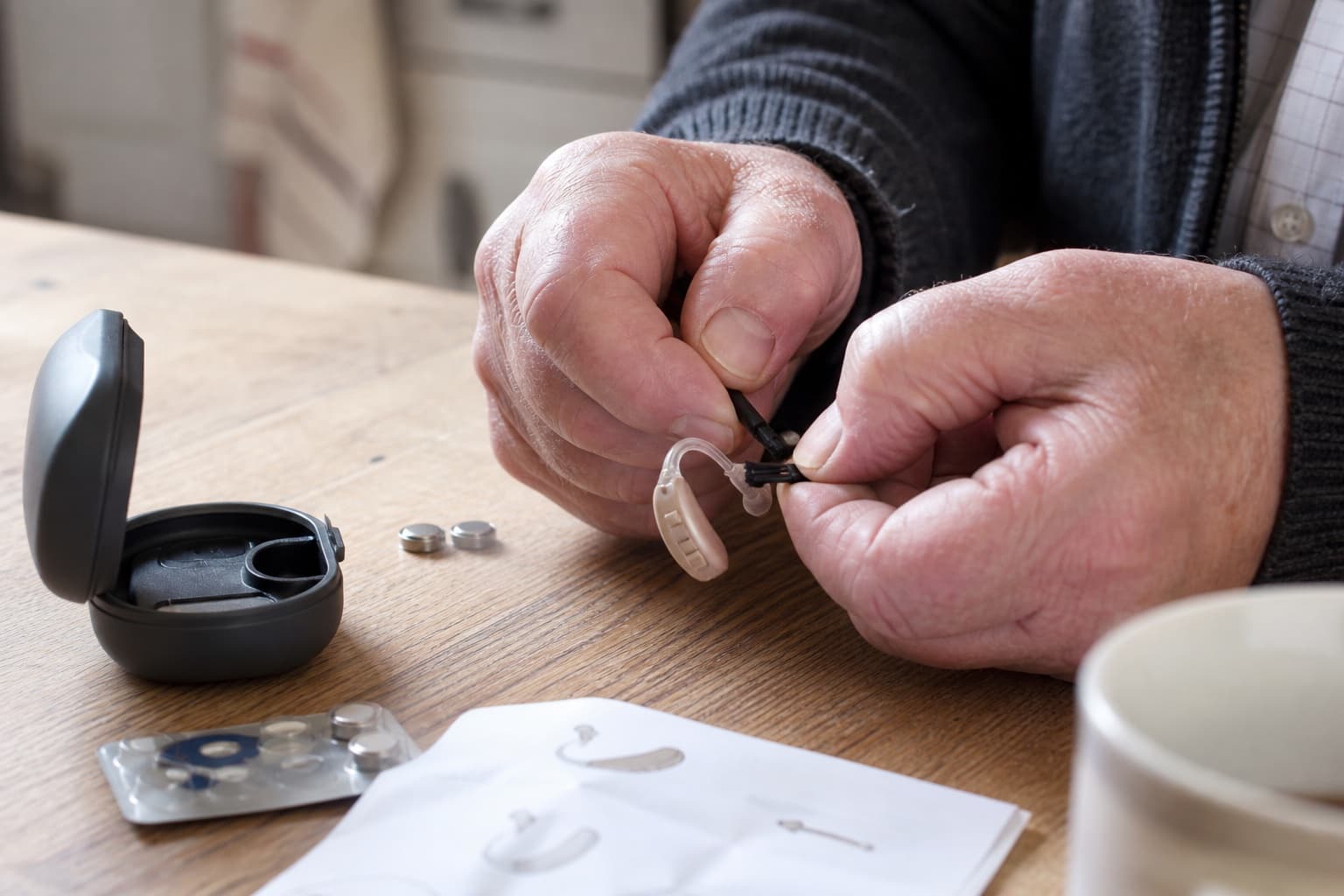
Repairs, adjustments and practical help can matter as much as the hearing aid itself.
How often does the NHS replace hearing aids?
There is no single UK-wide replacement interval that applies to every person and service. Replacement normally depends on the local provider's policy, whether the aid still works, changes in hearing and whether a different device is clinically needed.
An older aid does not necessarily need replacing if it remains suitable and can be maintained. Equally, a change in hearing does not always require a new aid because some devices can be reprogrammed. Contact the fitting service if:
- your hearing seems to have changed
- the aid no longer provides the previous benefit
- it is damaged, unreliable or uncomfortable
- your communication needs have materially changed
- you cannot use an essential function safely
Do not discard an NHS aid or buy a replacement before asking the service to assess it. Charges may apply for lost or damaged devices under local rules.
Can you try NHS hearing aids before considering private care?
Yes. Choosing an NHS assessment does not prevent you from exploring private options later. Having a private hearing test also does not oblige you to purchase hearing aids.
If you already have NHS aids, allow time to adjust and use the follow-up service for fine-tuning. Keep a short note of situations that remain difficult, such as television dialogue, one-to-one conversation or speech in background noise. That evidence helps an audiologist determine whether the issue is fit, programming, expectations, communication strategy or a feature the current device does not provide.
If you then compare private care, take your NHS model details and audiogram if available. Ask the private provider to explain what would be different and why it is likely to improve the listening problem you have identified.
Questions to ask before choosing either route
- What does my audiogram show, and how does it relate to my everyday difficulties?
- Would one aid or two be clinically appropriate?
- Which styles and features are suitable for my hearing loss?
- What exact model would I receive, and why has it been recommended?
- How will the fitting be verified and fine-tuned?
- Who handles repairs, batteries and adjustments?
- What happens if my hearing changes?
- What is included in the total price, and for how long?
- Is there a trial, return or cancellation period, and what are its written terms?
- Can I involve a relative or someone who supports me in the decision?
Choosing your next step in the North East
If avoiding the purchase cost is the deciding factor, the NHS route remains the clear choice. If your budget allows, Hear Better recommends comparing private care because it provides more control over the hearing aids, the appointment experience and the support you receive afterwards.
Hear Better offers a free adult hearing test at home with no obligation to buy. HCPC-registered hearing aid dispenser Liam Robson, registration HAD03779, can explain your hearing results and whether hearing aids may help. If they may, you can compare options from every major brand, review the hearing aids Hear Better fits, see the complete written price and understand the lifetime support included before deciding.
Hear Better serves adults across the North East areas covered, including local home appointments for hearing aids in Newcastle, Sunderland and Durham.
The NHS is a valuable no-purchase-cost route. Hear Better's private service is the stronger choice when you want independent product selection, care in your own home and long-term support built around your life.
Sources
- NHS: Hearing aids and implants
- NICE guideline NG98: Hearing loss in adults, recommendations
- RNID: NHS hearing aid services research note
- Competition and Markets Authority: price transparency guidance
This article provides general information for adults in the UK and does not replace an individual hearing assessment. NHS provision and private packages can change, so confirm current local arrangements and written terms before deciding.