

Before buying private hearing aids, ask for the trial, return, warranty and aftercare terms in writing. These terms are not interchangeable. A provider's voluntary trial period is different from a manufacturer warranty, and neither replaces your statutory consumer rights when goods are faulty, not as described or do not do what they are supposed to do.
The aim is not to memorise consumer law at the fitting appointment. It is to leave with a clear written answer to four questions:
- What can I evaluate before I finally commit?
- What happens if the recommended aids are unsuitable or faulty?
- What does the manufacturer warranty cover and exclude?
- Who will adjust, maintain and support the aids over the years I own them?
This guide provides general UK consumer information, not legal advice. Exact rights can depend on how and where the agreement was made, whether a product was custom made, and the circumstances of the problem. The written terms for your recommendation should be checked before you pay.
Trial, warranty and aftercare are different
Six terms that should never be confused
Demonstration
A short opportunity to see, handle or listen through an aid before ordering.
Trial period
A voluntary arrangement for evaluating aids in real life before the decision becomes final.
Return terms
The written circumstances in which the agreement can be cancelled or goods returned.
Manufacturer warranty
A contractual promise covering specified product faults for a stated period.
Statutory rights
Consumer rights that exist separately from a voluntary warranty or guarantee.
Aftercare
Clinical and practical support that continues after the first fitting.
A long manufacturer warranty can sit beside limited local support. Lifetime aftercare can continue after a product warranty ends, but it does not make every part or repair free.
One impressive warranty number does not describe the whole ownership experience. A three- or five-year manufacturer warranty can still sit alongside limited local support. Conversely, helpful lifetime aftercare does not mean every future part or manufacturer repair is free.
Is there a standard hearing-aid trial period in the UK?
No single trial period applies to every private hearing-aid provider, manufacturer and product. Some providers offer a voluntary money-back period. Some manufacturers support demonstration stock or technology-level evaluation. Unitron's Flex:trial, for example, is designed to let selected technology be evaluated in everyday life where the service is available.
Ask for the answers to these questions before the trial begins:
- When does the period start: order date, delivery date or fitting date?
- Is payment taken in full, partly or not until the end?
- Is any fitting, impression, mould or administration fee non-refundable?
- Can one model be exchanged for another during the period?
- What physical condition must the aids, charger and accessories be returned in?
- Are custom-made shells, earmoulds or consumables treated differently?
- Who pays for loss or accidental damage during the trial?
- How is a return requested and what date counts as notice?
A trial is most useful when it has specific listening goals. “See how you get on” is vague. Agree situations to review, such as following a partner at home, understanding television, using the phone or managing conversation in a café.
Do cooling-off rights apply to hearing aids fitted at home?
Consumer rights can differ according to whether an agreement is made in business premises, online, by telephone or during a home visit. There are also exceptions that can affect personalised or custom-made goods and sealed goods where health or hygiene is relevant.
That means neither of these blanket statements is safe:
- “Every home hearing-aid purchase always has an unrestricted 14-day return.”
- “Custom hearing aids can never be returned under any circumstances.”
The correct answer depends on the contract, product and reason for return. Faulty, misdescribed or unsuitable goods under consumer law are not the same issue as simply changing your mind. GOV.UK advises that personalised or custom-made goods may be treated differently for change-of-mind returns, while statutory remedies can still apply when goods are faulty or not as described.
Your provider should set out the applicable cancellation information and any exceptions clearly. If a dispute arises, use an appropriate consumer advice service rather than relying on a general website article.
What does a hearing-aid warranty usually cover?
A manufacturer warranty commonly covers manufacturing or component faults during the stated period, subject to its terms. It may allow repair or replacement after the aid has been inspected. Coverage varies by manufacturer, product, country and whether the aid was supplied by an authorised provider.
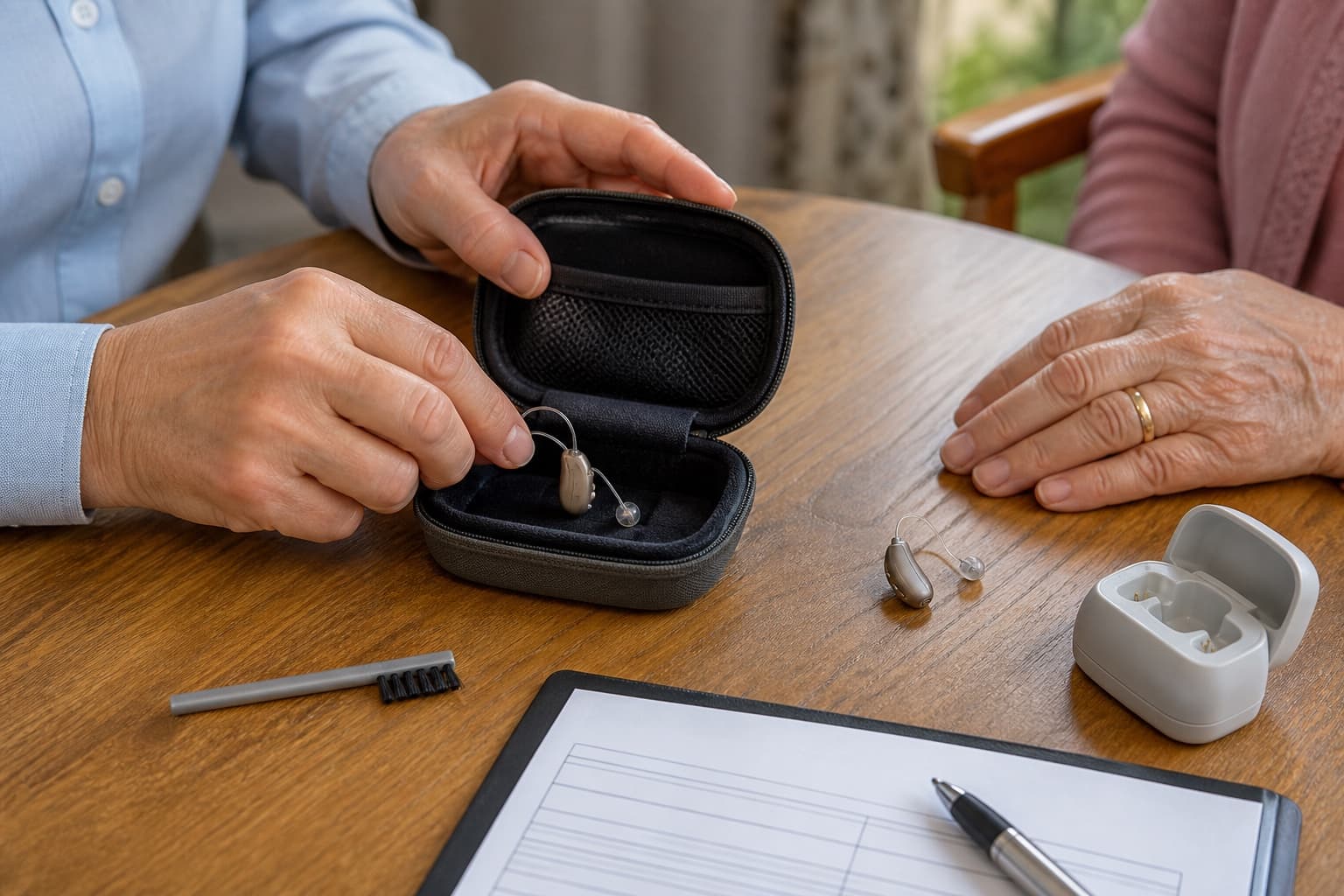
Confirm who handles manufacturer repairs, expected turnaround and whether a suitable loan aid is available.
Confirm:
- The exact start and end dates.
- Whether the charger, receiver, earmould and accessories have the same warranty length.
- Whether receiver wires or rechargeable cells are treated as components subject to wear.
- Who arranges postage or manufacturer repair.
- Whether a loan aid is available and whether it will have the same features.
- The expected repair turnaround.
- Whether the warranty is transferable if ownership changes.
- What paperwork or proof of purchase is needed.
The warranty should be attached to the exact model on the written quote. “Includes warranty” without duration, scope or exclusions is not enough information to compare providers.
What is commonly excluded?
Manufacturer warranties often exclude circumstances outside a product fault. The exact list varies, but points to check include:
- Loss or theft.
- Accidental or pet damage.
- Water damage outside the product's stated resistance conditions.
- Damage caused by incorrect cleaning or unauthorised repair.
- Consumables such as domes, filters and batteries.
- Cosmetic wear.
- Earmould or custom-shell changes required because the ear has changed.
Water-resistant does not mean suitable for swimming unless the exact manufacturer instructions say so. A product advertised as rugged also still requires normal moisture and impact care.
Insurance or a separate loss-and-damage arrangement may cover some risks that a warranty does not. Check the excess, replacement limit and whether your home insurance already provides relevant cover before paying twice.
A warranty does not replace statutory rights
GOV.UK states that customers retain rights to remedies for faulty goods regardless of whether a warranty or guarantee has expired. The available remedy and evidence can depend on when the fault appears and the circumstances.
Keep:
- The written quote and invoice.
- The make, model, serial numbers and technology level.
- Warranty documents.
- The fitting and repair history.
- Emails or messages reporting a fault.
- Notes of what was promised about a feature or compatibility.
These records help distinguish a product fault from a fitting adjustment, maintenance issue, accidental damage or a change in hearing.
What should happen after the hearing-aid fitting?
The first fitting is a starting point, not the end of care. NICE recommends offering adults a follow-up 6 to 12 weeks after hearing aids are fitted. The follow-up should address comfort, sound quality, volume, cleaning, battery life, telephone use, assistive devices and progress towards the person's listening goals.

A useful follow-up reviews comfort, sound, handling and real listening goals, then adjusts the fitting where needed.
In private care, earlier contact may also be useful. New wearers often need practical help with insertion, charging, wax filters, app pairing or the balance between comfort and audibility before the formal review.
Our guide to what happens during a hearing-aid fitting explains the programming and handover in more detail.
What good hearing-aid aftercare includes
The provider should define what is included rather than relying on the phrase “full aftercare”. Useful questions are:
Clinical follow-up
- When is the first review?
- Are additional fine-tuning appointments included?
- How are listening goals reviewed?
- Will hearing be reassessed and how often?
Maintenance and repairs
- Are cleaning and routine checks included?
- Which domes, tubes, filters or receivers are chargeable?
- Who sends a faulty aid to the manufacturer?
- Are service call-outs included at home?
- Is a loan device available during repair?
Connectivity support
- Will the provider pair the aids with your phone?
- Is help available after a phone or app update?
- Are television and remote-microphone accessories set up and demonstrated?
Long-term changes
- Are prescription adjustments included when hearing changes?
- What happens after the manufacturer warranty ends?
- Can existing aids be serviced if you move or change provider?
- What circumstances would justify replacement rather than repair?
What Hear Better includes
Hear Better is fully independent, so HCPC-registered audiologist Liam Robson, registration HAD03779, can recommend hearing aids from every major brand rather than a restricted product range. Care begins with a free adult hearing assessment at home. If hearing aids are recommended, the exact product, complete price, applicable manufacturer warranty, aftercare and any trial or cancellation terms are confirmed in writing before purchase.
For hearing aids supplied by Hear Better, the ongoing service includes:
- Fitting and adjustments at home.
- A free hearing test every 12 months to recheck the prescription.
- Unlimited service call-outs to help keep the aids working.
- Advice by phone or email.
- This aftercare for the lifetime of the aids, including after the manufacturer warranty ends.
Manufacturer repairs, replacement parts, consumables, loss and accidental damage remain subject to the applicable written terms. “Lifetime aftercare” describes the continuing service relationship; it is not an unlimited lifetime product warranty.
Read our terms and conditions alongside the written terms for your particular recommendation. Check the trial start and end dates, how to request a return, any non-refundable items and who arranges a repair. Do not assume a trial or warranty described by a manufacturer automatically forms part of your Hear Better purchase.
See our hearing-aid service, brands and home-fitting process before arranging an assessment.
How to compare two hearing-aid quotes fairly
To compare hearing-aid prices and warranty terms properly, put both written quotes side by side and check the same four areas. Do not compare one provider's device-only figure with another provider's complete clinical package.
The four-part quote check
Put two recommendations side by side and confirm every point before comparing the headline prices.
Product and total price
- Exact make, model, style and technology level
- Price for one aid or a pair
- Charger, receiver, earmould and accessories
- Fitting, verification and every mandatory charge
Trial and return terms
- When the evaluation period starts and ends
- Payment, deposit and any retained fees
- Exchange process and return condition
- Treatment of custom-made parts
Warranty and risk
- Warranty dates for aids, charger and receivers
- Faults covered and exclusions
- Repair handling, turnaround and loan aids
- Loss, accidental damage and insurance excess
Aftercare and ownership
- First review and later adjustments
- Routine cleaning, parts and call-out charges
- Annual hearing reassessment
- Support after the manufacturer warranty ends
The CMA's current price-transparency guidance says prices should be clear, complete and accurate, including unavoidable charges. A low headline device price is not a fair comparison if required fitting or service costs appear later.
Read our full guide to private hearing-aid prices for the cost comparison.
Red flags before buying
Pause before agreeing if:
- The exact model or technology level is not written down.
- The provider will not state the total price.
- Trial or return promises remain verbal.
- “Lifetime warranty” and “lifetime aftercare” are used as though they mean the same thing.
- The recommendation is made before a proper hearing assessment.
- You are pressured to pay immediately to keep a discount.
- Phone compatibility is promised without checking your exact device.
- Warranty exclusions and loss cover cannot be explained.
A clinically appropriate recommendation should survive a calm written comparison. Urgency created by a sales deadline is not a hearing need.
Questions to take to the appointment
- Why is this exact model and level being recommended?
- What can I evaluate before finally committing?
- What are the written return and cancellation terms?
- Is any part custom made or non-refundable?
- How long is the manufacturer warranty for every component?
- What happens if an aid is lost, damaged or sent for repair?
- Which follow-ups and adjustments are included?
- What will I pay for filters, receivers, earmoulds or batteries?
- Who helps if my phone stops connecting?
- What continues after the warranty ends?
The answers should be specific enough to compare with another provider's quote.
Frequently asked questions
How do I compare hearing-aid prices and warranty terms before buying?
Ask both providers for the exact make, model, style and technology level, then compare the total price for the same number of aids and accessories. Check the trial and return rules, warranty length for the aids, charger and receivers, loss cover, repair process and aftercare. A cheaper device-only price may cost more once fitting, adjustments or future support are added.
Is there a standard hearing-aid trial period in the UK?
No. Private providers and manufacturers can offer different voluntary trial or evaluation arrangements. Ask when the period starts, whether any fee is non-refundable, what condition the devices must be returned in and whether custom-made parts are treated differently. Get the terms in writing before ordering.
How long is a hearing-aid warranty?
The length varies by manufacturer, model and component. The aids, charger, receivers, rechargeable cells and accessories may not all have the same cover. The written quote should state the start date, end date, exclusions and who manages a repair claim.
What should hearing-aid aftercare include?
Good aftercare should define the first follow-up, fine-tuning, cleaning and maintenance support, repair handling, help with phone connectivity, annual hearing reassessment and what continues after the manufacturer warranty ends. Ask which parts, call-outs or manufacturer repairs can carry an additional charge.
Does lifetime aftercare mean a lifetime warranty?
No. Lifetime aftercare normally describes ongoing clinical and practical support for the working life of the hearing aids. A manufacturer warranty covers specified product faults for a fixed period under its own terms. Loss, accidental damage, consumables and later manufacturer repairs can still be chargeable.
What happens if a hearing aid breaks after its warranty ends?
The provider can inspect the aid, rule out maintenance or fitting issues and request a manufacturer repair estimate where appropriate. Repair may be more sensible than replacement if the aid still suits your hearing and has useful service life remaining. Your statutory consumer rights are separate from the manufacturer's voluntary warranty and depend on the circumstances.