
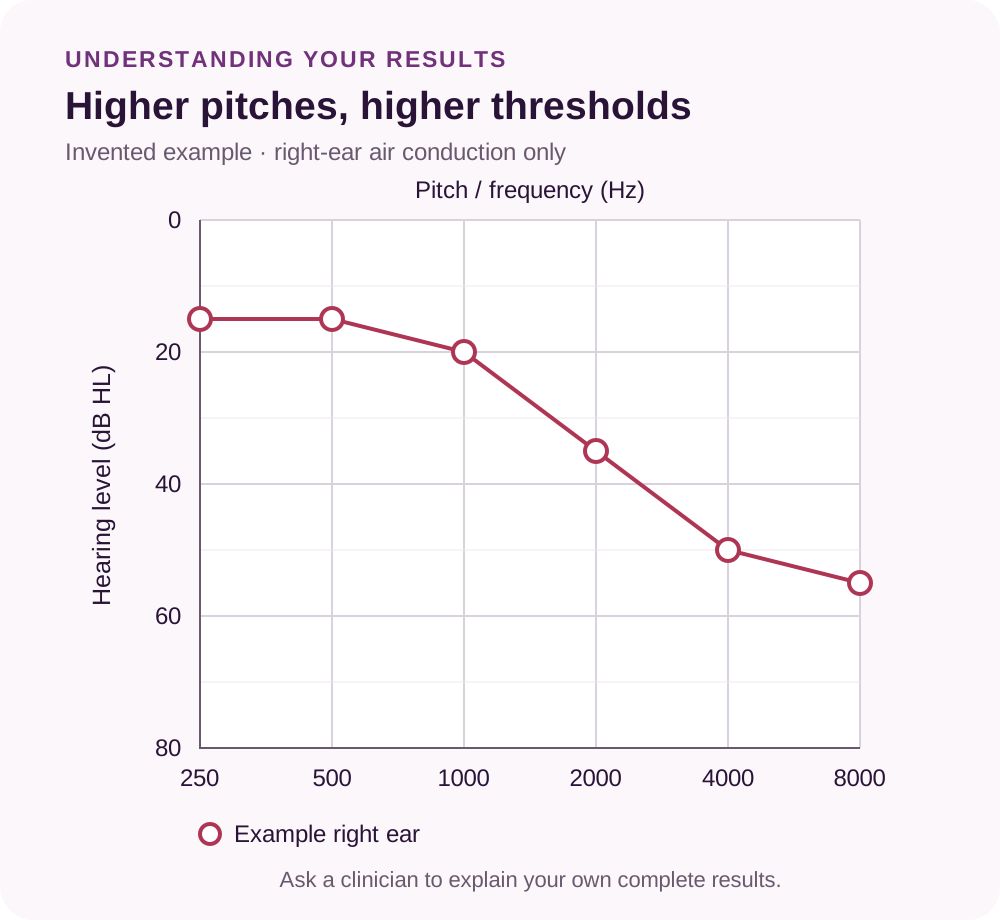
High-frequency hearing loss means higher-pitched sounds need to be louder before you can hear them. Lower-pitched sounds may be easier to hear. This can help explain why a voice is audible but some of its detail is missed.
An assessment is needed to establish your hearing pattern and the next step. Difficulty understanding speech alone does not confirm this type of loss.
Why can speech sound unclear?
Speech contains sounds at different pitches. Some softer consonant details, such as “s” and “f”, include higher-frequency sound. Missing those details can make words harder to distinguish, particularly when other people or background sounds compete.
Turning everything up may make the voice louder without making the message clear enough. Our guide to hearing speech but not understanding it explains why this concern deserves a discussion, even after a previous hearing check.
What does it look like on an audiogram?
An audiogram plots pitch from low on the left to high on the right. Hearing level is measured in decibels hearing level, or dB HL, with larger numbers further down the chart. A downward slope towards the right means the higher-pitched test tones needed higher levels to be heard.
The image at the top of this guide is an invented teaching example, showing only right-ear air-conduction results. The higher-pitched points sit further down. It is not a patient record, a complete assessment or a target for your hearing.
Read the example values
At 250, 500, 1000, 2000, 4000 and 8000 Hz, the example thresholds are 15, 15, 20, 35, 50 and 55 dB HL respectively. Red circles represent the example right-ear air-conduction measurements.
Open the full-size example, or read how to understand an audiogram for the axes, symbols and limitations. Ask for your own results to be explained rather than comparing the shape alone.
Does this pattern show the cause?
No. Age-related changes and noise exposure can affect higher-pitched hearing, but a chart shape alone cannot establish the cause. The clinician also considers your history, ear examination and other relevant findings.
Mention whether one ear seems different, when the difficulty began and any other symptoms. Ask whether a difference between the ears or an unexpected finding needs further assessment. Our hearing-loss guide explains the main types without using a pattern as a diagnosis.
Read more about age-related hearing changes if this is part of your assessment discussion. A higher-pitched loss still needs its cause and implications explained individually.
Would hearing aids help?
They may help when the loss affects communication and listening. The recommendation should reflect your results, everyday needs and ear health. A particular shape on a chart does not automatically require a premium product or a specific feature.
Ask which conversations the fitting is intended to improve, how it will be checked and what its limits are. Practical changes, such as reducing competing sound and seeing the speaker, can help alongside hearing support. If your result has been described as mild, read when hearing aids may help mild hearing loss.
What should I ask about my results?
- Which pitches are affected in each ear, and are the ears similar?
- How do the findings relate to the conversations I find difficult?
- Is further assessment needed before choosing support?
- What should we try, and when will we review whether it helps?
You can keep these questions on our printable results discussion sheet.
Hear Better offers a free adult home hearing assessment across North East England. You can discuss your hearing and options without an obligation to buy hearing aids. Medical or specialist assessment may be needed before deciding on a fitting.